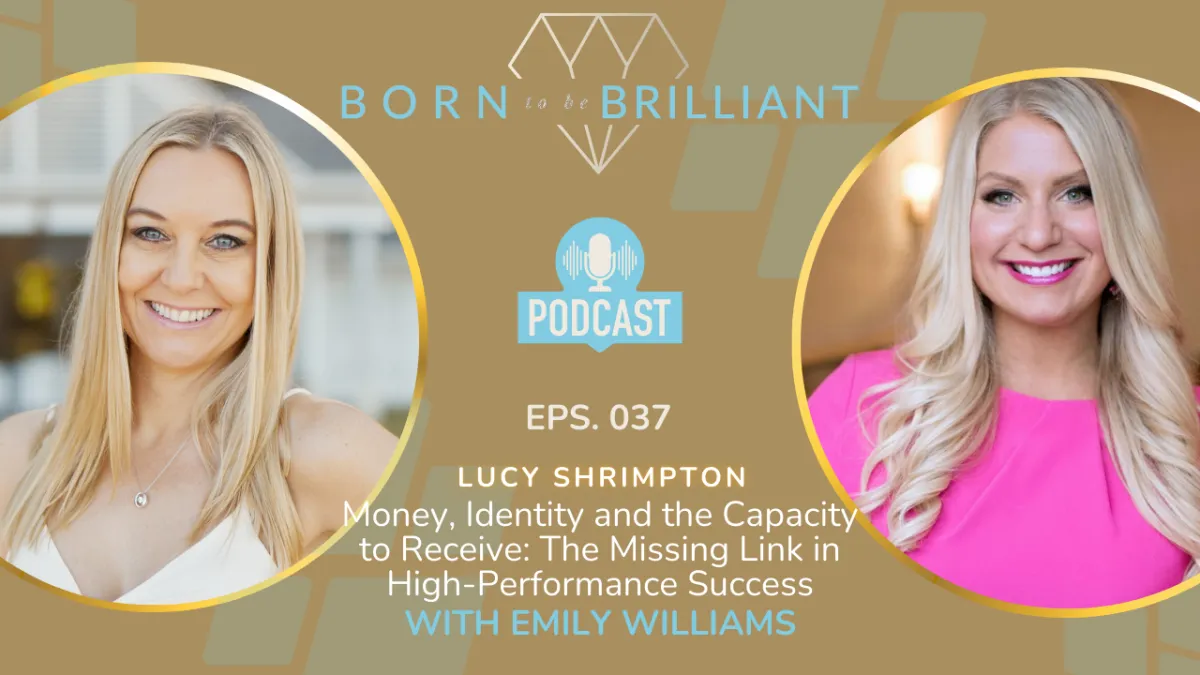
Money, Identity and the Capacity to Receive: The Hidden Architecture Behind High-Performance Success
Money is never just about money.
It carries stories, identity, family conditioning and deeply rooted beliefs that shape the way we move through the world long before we realise it. For many ambitious, heart-led individuals, the relationship with money is often the one place where confidence wavers, logic collapses and old patterns quietly run the show.
This episode of the Born To Be Brilliant® Podcast with money mindset expert Emily Williams takes us exactly into that terrain. Not the surface-level conversation about pricing or strategy, but the deeper psychology of what it means to receive, hold and feel worthy of abundance.
What emerges is a conversation about identity, safety, expansion and the internal frameworks that determine what we believe is available to us.
The Unseen Money Story Most High Performers Carry
Many people begin entrepreneurial life with passion, purpose and a sense of possibility. What they don’t realise is that they also carry an invisible script about money, often inherited from childhood or shaped by the environments they grew up in.
Phrases like “money doesn’t grow on trees” or “don’t be greedy” sound innocent enough, yet they create subtle programming that frames money as scarce, unsafe or even morally questionable.
Emily explains that these beliefs go far deeper than mindset. They become part of our sense of identity. If you grow up believing that wealth is for “other people”, that receiving too much is selfish, or that money disrupts relationships, you’ll subconsciously shape your behaviour to protect yourself.
Receiving Can Feel Harder Than Giving
This was one of the most powerful threads in the conversation.
So many heart-centred individuals are exceptional at giving, nurturing and supporting others, yet receiving – whether it’s money, support, recognition or spaciousness – triggers discomfort.
Receiving asks us to stand in our worth.
Receiving asks us to believe we matter.
Receiving asks us to stretch into an expanded version of ourselves.
For many, that expansion feels unsafe. Emily describes this as the “capacity to receive” – a psychological bandwidth for wealth and abundance that is often far smaller than our desires.
Why Strategy Isn’t Enough
There’s a moment where strategy takes you as far as it can, and your internal wiring begins to set the limit.
You can execute the perfect plan, show up consistently and do all the things you’re “supposed” to do, yet still feel capped.
This is often where high performers misunderstand what’s happening.
They push harder, assuming the problem is effort.
In reality, the problem is identity.
If you’ve not become the person who can hold success, you won’t keep it. It will slip away through self-sabotage, over-giving, shrinking or overcompensating.
Money always follows identity.
The Generational Layer
Emily also speaks about the generational imprinting many of us carry.
Our parents or grandparents may have lived through scarcity, uncertainty or financial instability. Their beliefs become part of the family narrative, passed down in sentences, tone, or the way they approach small everyday decisions.
Even something as simple as feeling guilty for ordering room service, or not wanting to “bother” someone in a luxury environment, often has roots in inherited belief systems.
When we don’t examine those patterns, they become ceilings we never signed up for.
Environment Matters More Than We Think
One of the clearest themes is that environment either expands or constrains us.
If we surround ourselves with people who reinforce scarcity – “people can’t afford that anymore”, “the market is tough”, “keep your head down” – we internalise those beliefs.
If we surround ourselves with expanders – people living the lives we aspire to, people thinking bigger, people for whom abundance is normal – our nervous systems recalibrate.
Expansion requires both courage and boundaries.
The Power of Micro-Upgrades
Emily offers a simple, grounded practice:
Imagine the version of you who already has the financial freedom you desire. What would they do, wear, choose or prioritise?
Then take one small step that aligns with that identity.
Micro-upgrades build self-trust.
Self-trust expands capacity.
Capacity changes outcomes.
A Final Word on Regret and Timing
Many people look back and think, “I should have done this sooner” or “I missed my window”. Emily reframes this beautifully. You learn the lesson when you’re ready for it. Timing is never late. Every experience expands you, even the difficult ones.
There is no wasted time when you are willing to evolve.
Listen to the Full Conversation
If this article resonates, the full episode goes even deeper into the psychology, emotion and identity behind money, wealth and expansion.
You can watch the episode on YouTube or listen on your favourite podcast platform


