When Your Business Is Successful, But You’re Not Okay
There is a particular kind of loneliness that can come with building something that looks successful on paper, but feels quietly unsustainable in real life.
It is not the dramatic “everything is falling apart” version of struggle that people readily understand. It is subtler than that. The business is functioning. The income is coming in. People might even tell you how well you are doing. Yet your days feel increasingly compressed, your nervous system is always on, and the freedom you started out craving seems to have moved further away the harder you have worked.
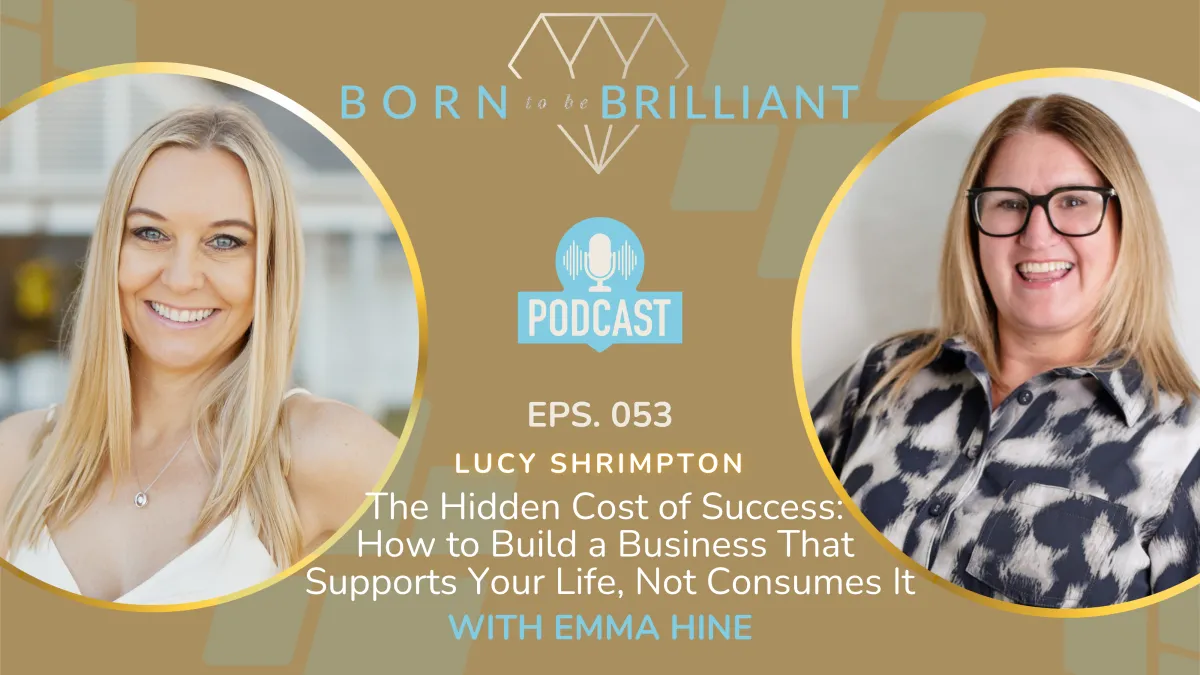
This was the heart of my conversation with business growth strategist Emma Hine. Emma built a business that turned over more than a million pounds a year, and from the outside it appeared to be thriving. Internally, she was experiencing something very different. Over time, the business consumed her life to the point where she could no longer ignore the cost.
Her story is an extreme example of a pattern I see often, and perhaps you do too. Many entrepreneurs do not set out to build themselves a prison. They set out to build a life. But if you are not intentionally designing a business around what you actually want, the default setting tends to be more. More responsibility. More complexity. More pressure. And eventually, less space.
The Quiet Drift From Freedom To Obligation
The first reason this happens is deceptively simple. When you are building, you make decisions for speed and survival. You do what works. You say yes because you need to. You keep things moving because it is you, and the buck stops with you. That is not a flaw. It is what early-stage entrepreneurship often requires.
The issue is what happens next.
If you never pause to question the direction of travel, what began as a season of necessary effort becomes a permanent way of operating. You keep adding layers. You keep patching problems. You keep tying things together with whatever works in the moment. Emma described this brilliantly as “string and sellotape”, where a system breaks, so you attach something else, and then something else, until the whole structure is functioning but fragile.
The business might still be growing, but you are increasingly doing it at the expense of your wellbeing, your relationships, and the daily experience of your life.
Redefining Success In Real Terms
A moment that stayed with me from our conversation was Emma’s description of what she came to understand as success. Not the big milestones. Not the external markers. The small, ordinary freedoms that make life feel like yours.
A friend calling on a Tuesday and being able to say yes to a coffee on Wednesday. Time that is not rationed and scheduled weeks in advance. The ability to be present. The ability to breathe.
This is the part of entrepreneurship that people do not always talk about clearly. We can be deeply ambitious and still crave simplicity. We can want growth and still want spaciousness. We can be very capable and still reach a point where the business has become too heavy to carry in the way it is currently structured.
When we are not honest about what we really want, we chase a version of success that looks impressive but feels hollow. When we do get honest, we are suddenly able to make decisions that create the reality we actually want to live inside.
Systems Are Not Just Tech, They Are Self-Respect
I appreciated Emma’s approach to systems because it was grounded in reality rather than trend. She was not talking about tech for tech’s sake. She was talking about the practical truth that any repeated action in your business is, in effect, a system.
If you are manually recreating the same process over and over again, you are not only losing time. You are increasing the chance of human error, inconsistency, and unnecessary stress. You are also building a business that relies on you being available, well, and switched on at all times.
A supportive business is not one where you do everything perfectly. It is one where the essentials can run even when you are tired, unwell, grieving, travelling, or simply being a human being.
This matters more than most people realise. Not because we should expect life to go wrong, but because life will inevitably unfold. Emma spoke very openly about the reality that tomorrow is not guaranteed, and that point landed with force. When something profound happens, you do not want to look back and realise your business left no room for you to live.
The Question That Changes Everything
When you strip it back, the most useful question is not “How do I scale?” or even “How do I grow?”
It is: What am I building this for?
If you do not answer that question honestly, the business will answer it for you. It will pull you towards urgency, towards constant output, towards complexity, and towards a version of success that may not align with the life you actually want.
If you do answer it honestly, you start to build differently. You simplify. You automate what is repetitive. You protect what is meaningful. You make decisions with intention rather than habit. You stop proving your worth through exhaustion.
And you begin to create something that can sustain you.
If you want to listen to the full conversation with Emma Hine, you can find the episode here:
https://podfollow.com/born-to-be-brilliant
You can also explore what might be shaping your current patterns, strengths, and next chapter by taking my quiz here:
https://www.lucyshrimpton.com/quiz
And if you would like to connect with Emma, her website is:
https://emmahine.co.uk/


